
Where Predictive AI Meets Generative and Agentic AI
Originally published on Medium.
Like many people with a background in predictive AI and data science, we’ve been exploring generative and agentic AI. We keep coming back to two questions: how do these fields fit together, and where does our existing experience help?
Having led predictive AI and data science work across industries, we’ve seen growing interest in using generative AI to improve how that work gets done. We’re especially interested in the other direction: how predictive models can help generative AI systems and agents make better decisions. By agents, we mean generative AI systems that can use tools and take actions, so much of what follows applies to generative AI more broadly. Forecasts, risk estimates, and likely outcomes can give these systems more to work with. In our experience, that connection is still taking shape in enterprises, and it’s an area where data science practitioners have a lot to contribute.
Let’s look at both directions, starting with how generative AI is changing predictive modeling. We’ll then spend more time on how predictive models can help AI agents make decisions.
How generative AI helps predictive AI and data science
More capable models, faster development
Generative AI and the foundation models behind it are changing how we build predictive systems. Recommendation systems are a good example. Transformer models learn from sequences of customer interactions to predict what someone might click, buy, or do next. Generative recommenders take this further, using approaches similar to next-token prediction in LLMs to identify or rank items to recommend. [1]
Meta’s GEM and NVIDIA’s work on HSTU offer two examples. In its October 2026 GEM update, Meta describes an LLM-style architecture that learns from longer user histories and shares what it learns across advertising tasks. Meta reports improvements in prediction quality and training efficiency. NVIDIA’s September 2026 deployment work on HSTU, the generative recommender architecture Meta introduced in 2024, focuses on serving speed, reusing previously computed attention state to reduce the time needed to generate recommendations. Better models are part of the story; making them practical to run matters too. [2, 3]
The benefits extend beyond recommendations. Google’s TabFM applies in-context learning to classification and regression on tabular data. [4] LLM embeddings can turn text into useful inputs for predictive models, while coding assistants help teams build and debug them. Agents are also starting to take on more of the development process. Google’s MLE-STAR, for example, searches for suitable modeling approaches, writes code, and runs experiments to improve parts of a machine learning pipeline, such as feature engineering. [5] MLE-STAR is still a research example, but it shows how agents can help with the repeated experimentation that data science requires.
How predictive AI helps generative AI and agents
Adding predictions to the context agents use
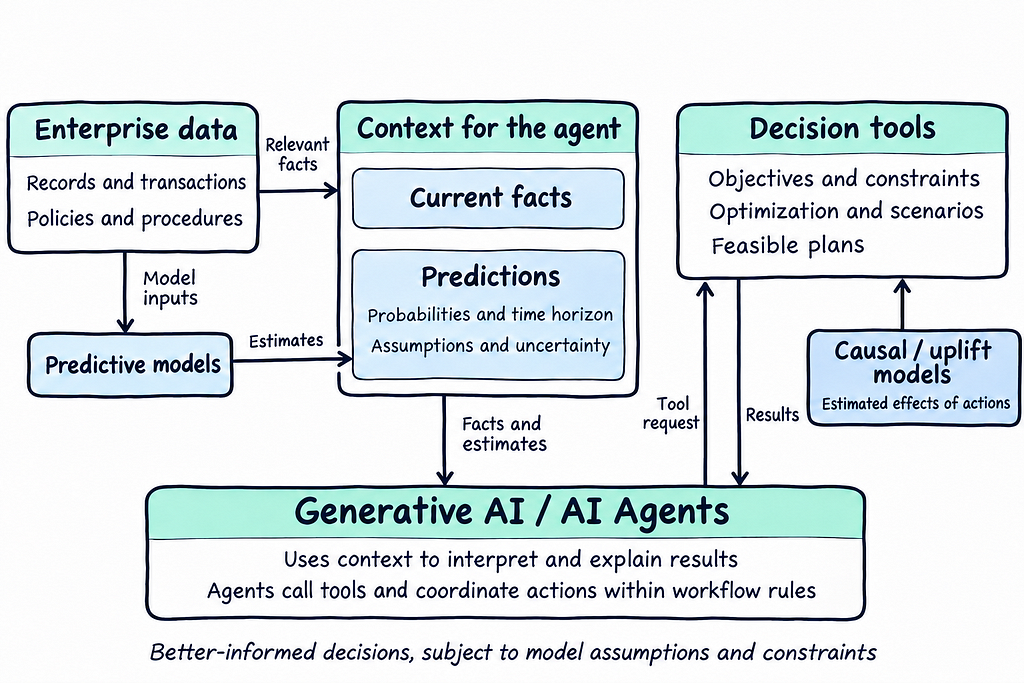
An enterprise agent may have access to customer histories, transactions, policies, and procedures. Predictive models add estimates of what might happen next, based on patterns learned from historical data. These estimates give the agent more to work with when deciding what action to take. Even a simple generative assistant answers better when it can ground its response in a forecast or risk estimate, but the value grows when an agent can act on it.
Predictive models help agents consider what might happen next, along with the assumptions and uncertainty behind each estimate.
What this looks like in practice
Consider a customer engagement example. A model estimates how likely a customer is to buy a particular product within the next 30 days. An agent can use that estimate alongside the customer’s purchase history, recent service interactions, and product eligibility to decide whether outreach makes sense.
In a clinical support workflow, a validated risk model might estimate a patient’s likelihood of developing a condition over a defined period. An agent could bring that estimate together with relevant records and guidelines for a clinician to review. The estimate concerns future risk. It does not establish a current diagnosis.
In both examples, the predictive model gives the agent an estimate derived from patterns in data. The agent can use that result without having to infer those patterns from the underlying records itself.
A prediction needs context too
A score alone is not enough. The agent needs to know what it predicts, the time period it covers, and when it was calculated. It also needs information about the population the model was validated on, its assumptions, and its limitations. Those details help determine whether the prediction is useful for the decision at hand.
The probability of an outcome is also different from how much trust we should place in the estimate. A high purchase probability, for example, does not by itself tell us how reliable the prediction is for that customer. Calibration, validation results, and uncertainty estimates, where available, help us judge how much weight to give it.
Using probabilities does not mean giving up fixed rules. A customer may have a high predicted likelihood of buying, but outreach still needs to follow consent requirements, product eligibility rules, and contact limits. The prediction helps the agent decide whether outreach makes sense. The surrounding workflow determines whether it is allowed.
Predictions can come from stored scores or a live model call. Either way, what the score means, how old it is, and whether it applies to the current situation need to travel with it. Salesforce’s documentation provides an example of how predictive model outputs can be made available to agents. [6]
From predicting outcomes to choosing actions
A prediction helps us understand what might happen. Choosing what to do requires another step. A customer with a high likelihood of buying may purchase without an offer. Uplift models estimate how much an offer might change that likelihood, provided the data and assumptions support a causal interpretation. [7]
Decision science helps turn these estimates into a plan. Mathematical optimization, for example, searches for actions that meet a stated objective while respecting constraints. In customer outreach, it can help decide who receives an offer within budget, eligibility, consent, and contact limits. In clinical planning, it can help allocate follow-up resources according to clinician-defined priorities, guidelines, and available capacity.
Uncertainty matters here too. Teams can compare plans across different scenarios or use stochastic or robust optimization to account for uncertainty explicitly. The preferred plan depends on the objective, assumptions, and tolerance for risk. These approaches help assess possible futures; they do not guarantee what will happen. [8]
An agent can call an optimization tool, request alternative scenarios, and explain the resulting trade-offs. Microsoft’s OptiGuide provides a practical example: it combines generative AI with optimization to help supply chain planners ask “what if” questions and understand the recommendations. [9]
What this means for data science practitioners
Experience in building, deploying, and monitoring predictive models remains essential. Statistical judgment, domain knowledge, MLOps, and engineering skills provide a strong foundation for bringing these models into agent workflows.
That work brings new responsibilities. Practitioners need to define what a model’s output means, when a prediction needs updating, and when it is appropriate for an agent to use it. They also need to evaluate what happens after the agent acts. If an agent uses a purchase score to send an offer, that offer may change the customer’s behavior. Evaluation therefore needs to consider both the quality of the prediction and the effect of the action taken.
For practitioners, this means building on existing skills and learning how to connect models to agent workflows. As more development tasks become automated, we expect greater emphasis on choosing useful problems, testing assumptions, and showing whether a system improves decisions in practice.
The connection works in both directions. Generative AI and agents can help us build and improve predictive models. Predictive models and decision science, in turn, can help agents assess possible outcomes and choose actions within defined constraints. For those of us coming from data science, this naturally extends our work from making predictions to improving the decisions they inform.
References
- NVIDIA. How Generative Recommenders Are Redefining RecSys at Scale.
- Meta Engineering. Meta’s Generative Ads Model (GEM): Scaling the Central Model and Compute Engine for Frontier Ads AI.
- NVIDIA. Deploying an HSTU Generative Recommender with NVIDIA Dynamo-Triton.
- Google Research. Introducing TabFM: A zero-shot foundation model for tabular data.
- Google Research. MLE-STAR: A state-of-the-art machine learning engineering agent.
- Salesforce Help. Use Predictive AI with Agents and Prompt Templates.
- Scikit-uplift documentation. Causal Inference: Basics.
- Gurobi Optimization. Provable Optimality: What a Solver Guarantees, and What It Doesn’t.
- Microsoft Research. OptiGuide: GenAI for Supply Chain Optimization.